From Calling Card to Matchmaking Profile
Calling card to matchmaking profile: see how these introductions differed in purpose and context, and learn to separate what they say from what readers infer.
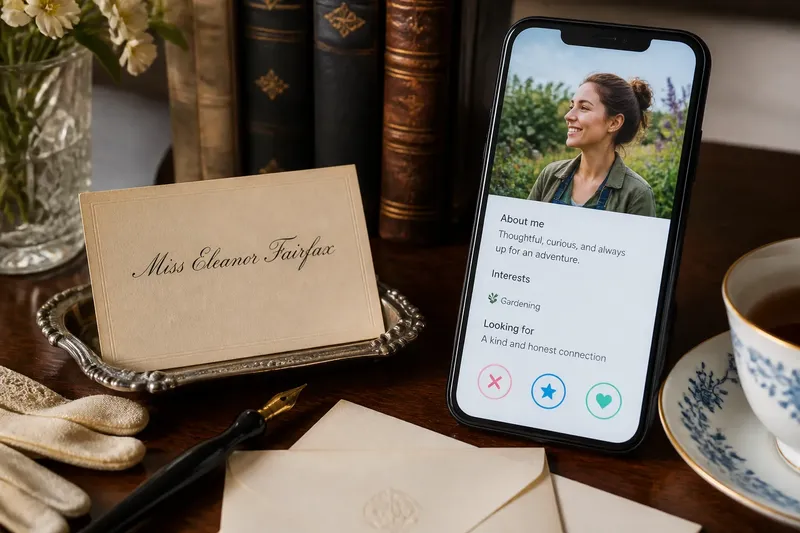
A calling card left at a household in nineteenth-century Britain offered a name and a social gesture, not a biography. Calling card to matchmaking profile is a useful comparison only when its setting stays in view: the card belonged to conventions around visits, while contemporary profiles gather chosen details for people considering an introduction.
These formats did not form a single, universal path from one era to another. Calling-card customs varied by place and period, and a card was not necessarily a matchmaking instrument. The comparison is narrower and more revealing: each format presented someone to an audience, while leaving much of that person beyond the page.
Calling-card customs
In nineteenth-century Britain, calling cards were used in formal visiting among people who followed the relevant social customs. A card could identify a caller and signal a visit or an attempt at contact. Its meaning depended on the household’s conventions and circumstances; the card itself did not explain a person’s character or intentions.
For a possible introduction, the card might provide a name that household members could discuss or ask about. Any additional account would come through other channels, such as a conversation with a mutual acquaintance. That context should not be mistaken for something printed on the card.
Imagine a household receives a card from someone its members do not know. They can identify the visitor’s name, then ask a mutual acquaintance how they know each other before deciding whether to arrange a conversation. The observable result is a better-informed next exchange—not a complete judgment of the visitor.
Read the card as evidence of a social contact, not as a compact portrait.
Introductions by word
In settings where relatives, friends, or intermediaries arranged introductions, an account of a prospective match could travel by conversation or letter. The speaker might mention family circumstances, temperament, or shared interests, depending on what seemed relevant to the intended audience. Those details were selected and shaped by the person telling the story.
This does not mean every earlier introduction followed the same pattern. Practices differed across communities, households, and periods. A useful question is specific: who supplied this description, for whom, and with what purpose?
A spoken account could shift as it passed between people. A written letter held its wording, but still reflected the writer’s choices. Neither format offered a neutral, complete record of the person being described.
When reading an introduction, separate what the speaker says from what the audience is invited to infer.
Profiles and selection
A matchmaking profile can place a photograph, biography, preferences, and prompts together. That offers more chosen detail than a calling card, but it does not make the profile a fuller account in every meaningful sense. A person selects what to include, and the service’s fields shape how the information is presented.
Readers also add their own interpretations. A stated hobby does not establish someone’s temperament, and a list of preferences cannot settle how two people will communicate. The profile can give a conversation a starting point; direct interaction supplies a different kind of information.
Compare like with like: a card’s role in a particular visiting custom and a profile’s role in its own introduction setting. Neither format should be treated as a verdict on compatibility.
How should you read each format?
What did a calling card communicate?
In the British visiting customs described here, it could identify a caller and signal a social contact. The household’s conventions and any knowledge outside the card shaped what happened next.
Was every calling card used for matchmaking?
No. A calling card belonged to visiting practices; it should not be described as a matchmaking tool in every setting. People could use other means, including conversation or letters, when arranging introductions.
What does a profile add?
A profile can collect self-description, preferences, photographs, and prompts in one place. These remain selected details, not a complete account of how someone behaves in a relationship.
How can you avoid overreading?
Separate explicit statements from your conclusions about them. If a detail raises a relevant question, use it to open a respectful conversation rather than treating it as proof of a trait.
A careful comparison
Use these checks when comparing a historical object or account with a present-day profile. Each observation should lead to a decision about what can—and cannot—reasonably be inferred.
- Check the place and period: If the object is identified as a British calling card from a particular period, then describe it within that context; if its origin is unclear, avoid assigning it a universal custom and seek more context.
- Check what is physically present: If a card shows a name or address, then report those visible details; if a detail is absent, do not infer the person’s character or circumstances from the omission.
- Check the intended audience: If a household received the card, then discuss the visiting gesture; if the audience is unknown, qualify claims about what the recipient was expected to do.
- Check who supplied extra information: If a relative or acquaintance provided an account, then identify it as that person’s description; if no source is known, do not present the account as established fact.
- Check profile fields and prompts: If a platform asks for preferences or interests, then distinguish the person’s response from the platform’s categories; if a relevant detail is missing, treat it as unknown rather than negative evidence.
- Check your own inference: If you conclude that a hobby reveals someone’s temperament, then mark that as an assumption and ask an open question; if there is no useful question, leave the conclusion undecided.
Say you are comparing a nineteenth-century British calling card that bears a name with a contemporary profile listing gardening as an interest. First, record the card’s visible name without assigning it a motive. Next, note that the profile states an interest in gardening, but does not explain what the person enjoys about it. Then keep the two contexts distinct: the card signals contact within a visiting custom, while the profile offers self-description for an introduction. The resulting answer is limited but clear: the profile provides more chosen personal detail, and neither item establishes compatibility.
What descriptions leave out
A sparse card may leave questions unanswered; a longer profile may create a feeling of familiarity without resolving them. In both cases, missing information is simply missing. It is not evidence that a person lacks a quality, nor a reason to fill the gap with a confident guess.
For a calling card to matchmaking profile comparison, keep the main search phrase tied to this distinction: format, audience, and context shape what each introduction can communicate. A profile gives a reader more words to consider, but the person still exceeds the description—and the next conversation should begin from what is actually stated.